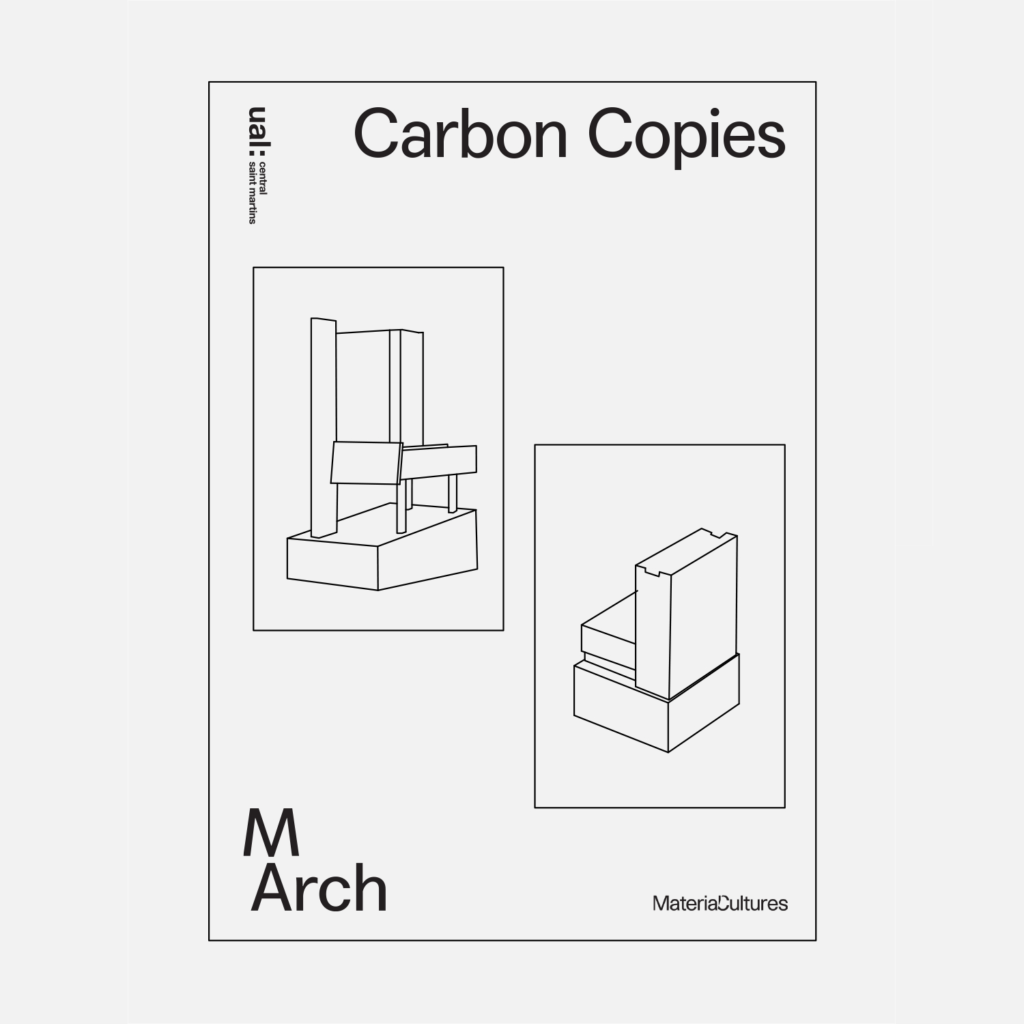
Carbon Copies
<p><em>Carbon Copies</em> is an investigation into the embodied carbon impact of residential typologies, exploring the relationship between the materials we build with and the impact they have on the environment.</p> <p>The built environment contributes over 40% to global carbon emissions and a radical change is going to be necessary if we are going to halt climate and ecological collapse. This means not only addressing the renewable energy sources but transforming the materials from which we make things, the supply chains that produce them and re-imagining construction’s relationship to ecology.</p> <p>The analysis takes five iconic residential typologies from the last century in and around London and proposes a Carbon Copy of the original designs using low-embodied carbon materials. The reinforced concrete frame of Keeling House is imagined as a rammed earth structure, the brickwork of a typical terraced house on Beck Road is remade in adobe brick insulated with clay and straw, and the monolithic concrete structure of Alexandra Estate is proposed in timber and hempcrete. A self-build system designed by Walter Segal is adapted to accommodate thick layers of natural insulation, and adjust to the available regional supply of biobased materials like straw and hemp, and the party walls of the Span House are detailed with unfired clay bricks and lime mortar. Embodied carbon analysis (A1 to A3) of the primary fabric of both the original and the Carbon Copies was carried out to assess the impact of the translation…</p>
Authors: Nina Anderson, Benjamin Holland, Katie Campbell, Jack Sweet, Jacob Phil-Ebosie, Leucotea Andriolo, Aya Mousa, Antonia Maisch, Sam Hawkins, Benedict Wigmore, Harry Jones, Holly Drinkwater, Ragavendran Gowrisankar, Sam Beasley, Will Bradley, Antoinette Oni, Sedayah Simpson, Sodueari Graham-Douglas, Jake Maddocks, Alexandros Xenophontos, Ceri Hedderwick Turner, Callum Campbell, Connie Beauchamp, Eloise Coleman, Flynn Williams, Will Hayter
Part of: Material Cultures Reports