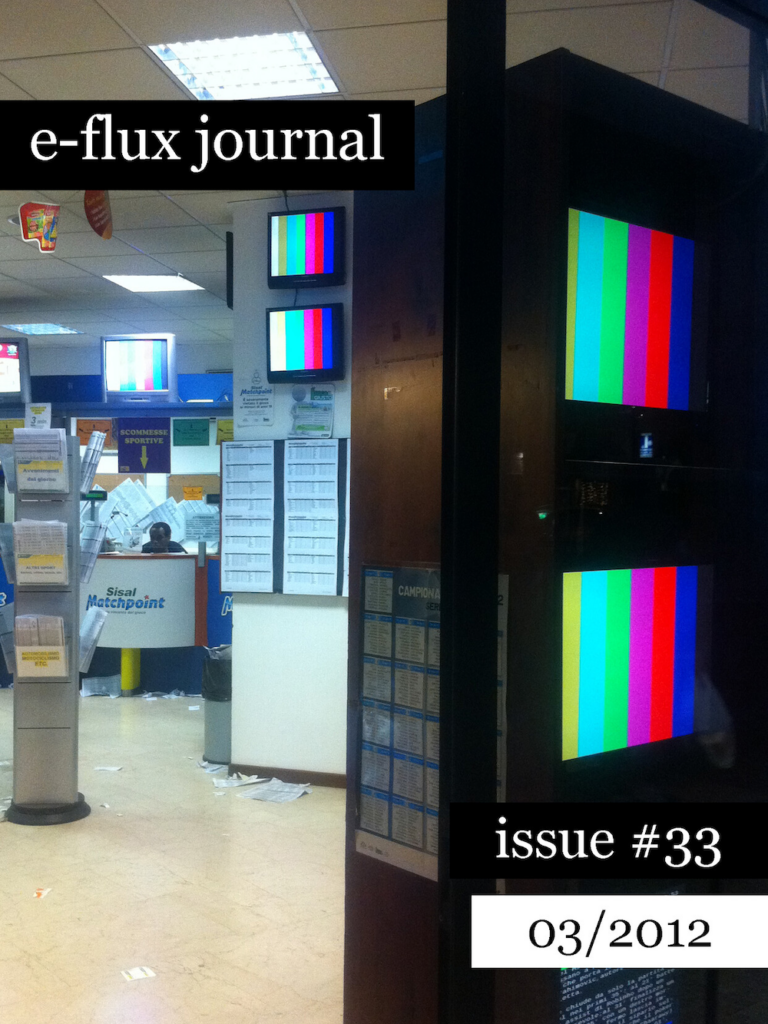
e-flux Journal #33
<p>On some days it is more apparent than others that the ground is shifting below our feet. On a clear day, we can see the horizon that tells us we are in the midst of a global regime change, yet we do not yet know the face of the new power just beyond it. But what we can see is the limit of an economic regime that has dangled vast advances in symbolic spheres of information and communication, in capital flows and even human movement across the globe. Perhaps it was only a matter of time before we realized the extent to which the freedom to move across borders required that the goods, information, and people being moved conform to protocols ensuring that they will be recognizable upon reaching their destination. Just as the movement of commodities presupposes a demand, for an artwork something similar happens where it must conform to an established, shared language of representation in order to be understood as art when it travels. It could even be said that this protocol has superseded the role of the exhibition space in deciding what can be presented as art…</p> <p><b>Editorial</b><br /> Julieta Aranda, Brian Kuan Wood, Anton Vidokle</p> <p><b>No Good Time for an Exhibition: Reflections on the Picasso in Palestine Project, Part I</b><br /> Michael Baers</p> <p><b>Politics of Hate in the USA, Part I: Repressive Tolerance</b><br /> John Miller</p> <p><b>Not-Mother: On Freud’s Verneinung</b><br /> Alenka Zupančič</p> <p><b>One Divides into Two</b><br /> Mladen Dolar</p> <p><b>In Conversation with Adam Curtis, Part II</b><br /> Hans Ulrich Obrist</p> <p><b>The Artistic Mode of Revolution: From Gentrification to Occupation</b><br /> Martha Rosler</p>
Editors: Julieta Aranda, Brian Kuan Wood, Anton Vidokle
Contributors: Julieta Aranda, Brian Kuan Wood, Anton Vidokle, Michael Baers, John Miller, Alenka Zupančič, Mladen Dolar, Hans Ulrich Obrist, Martha Rosler
Part of: e-flux journal
ISSN: 21641625