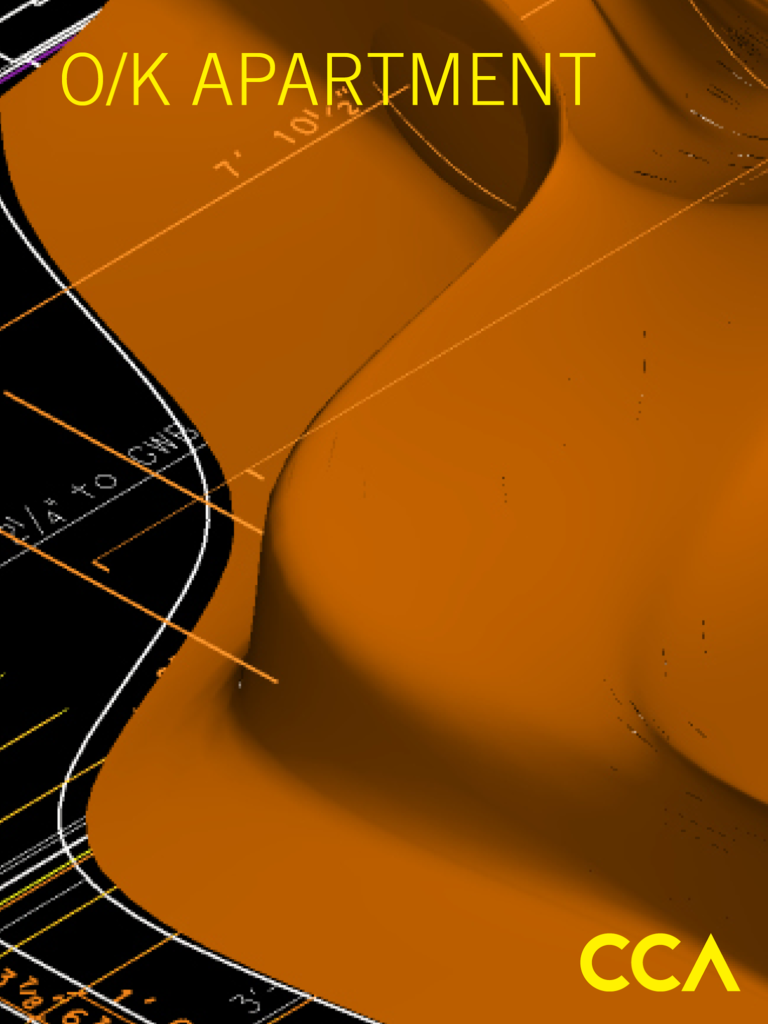
O/K Apartment
<p>Often referred to by one of its clients as “Cleopatra’s submarine,” the Ost/Kuttner loft converts two adjacent apartments in a pre–World War II building in New York City into a single but divisible space used as a pied-à-terre and guest house. Sulan Kolatan and William Mac Donald of KOL/MAC extended this hybrid character into the design of the renovation, drawing an analogy between the apartment layout and a city where various zones or sites can be activated and linked together.</p> <p>The loft is organized into areas defined less by their programmatic identities—bathroom, bedroom, living space—than by a series of undulating landscapes made up of custom, function-bridging forms, which Kolatan and Mac Donald developed by digitally compositing cross-sections of everyday domestic objects. These profiles were blended and allowed to propagate according to topological affinities, regardless of scale, generating what Kolotan and Mac Donald call a “co-citation” map of the apartment’s hybrid parts. To produce the pieces, the architects worked intensively with contractors in a process directly informed by computer-aided fabrication in fields such as transportation (boats), sports (bobsleds), and entertainment (stage sets). </p> <p>Completed at a moment when digitally driven design was just beginning to take root outside experimental environments like Columbia University’s school of architecture, the O/K Apartment was a testament to these forms’ “buildability.” Beyond acting as proof of the possibilities of direct-to-manufacture 3D modelling, however, the project also proposes a distinct aesthetic character native to and exported from a digital environment in which the virtual and the real ”become increasingly indistinguishable.</p>
Authors: Sulan Kolatan, William MacDonald
Editors: Greg Lynn
Editorial Coordination: Jayne Kelley
Design: Linked by Air
Media Coordination: Jim Bell, Jayne Kelley, Martina Amato
Transcription: Christiane Côté
Rights and Reproduction: Marc Pitre
Canadian Centre for Architecture
Part of: Archaeology of the Digital
ISBN: 978-1-927071-34-2