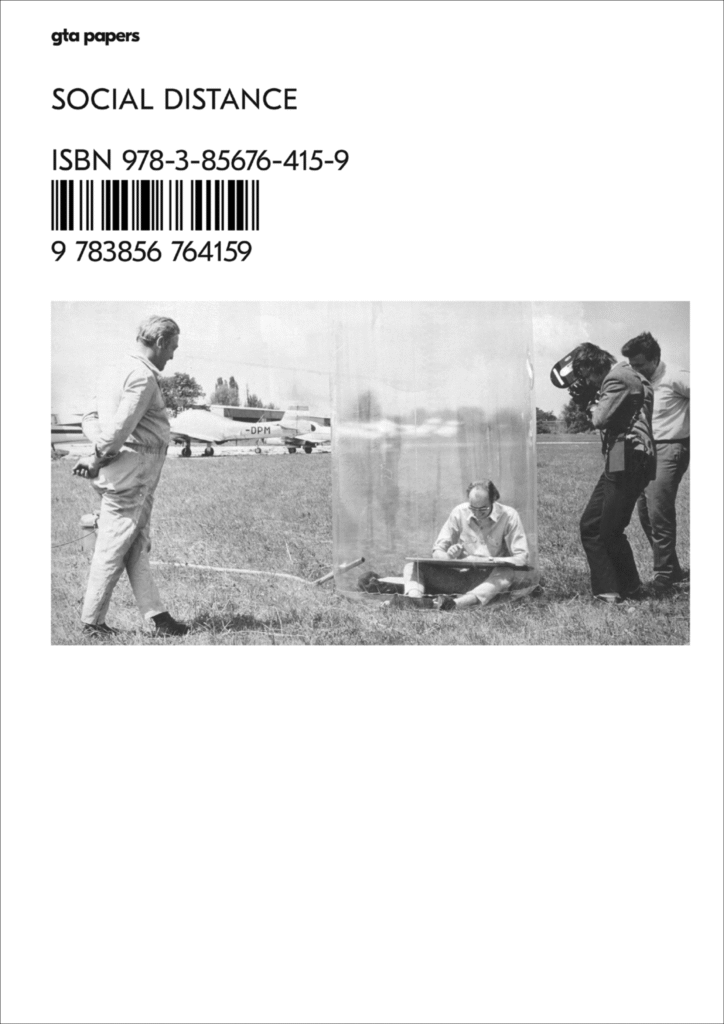
Social Distance
<p>The term ‘social distance’ was once only a vague metaphor to describe the relationship between different social groups. Yet it has acquired a precise meaning as the mandatory minimum distance for face-to-face interactions: 1, 1.5, or 2 metres (or 6 feet), depending on the jurisdiction. But what is the appropriate distance from which to interpret a pandemic? Rather than asserting a diagnosis of the contemporary emergency, the issue <em>Social Distance</em> offers perspectives from architectural history and theory. From the great plague of Venice to cholera in the industrializing city, from the human placenta to the 1960s or the bubble office of today, the fifth <em>gta papers</em> provides a broad range of reflections on contagion, disease, and health.</p>
Issue Editor: Adam Jasper
Contributors: Adam Jasper, Annmarie Adams, Gregorio Astengo, Chair of the History and Theory of Urban Design, Irina Davidovici, Didem Ekici, Caroline A. Jones, Christa Kamleithner, Jeanne Kisacky, Anne Kockelkorn, Miloš Kosec, Reinhold Martin, Stanislaus von Moos, Cathelijne Nuijsink, Laila Seewang, Lukas Stadelmann, David Theodore, Leslie Topp, Daniel Weiss, Alex Winiger, Markus Wörgötter, Lydia Xynogala
Academic Editor: Adam Jasper
Copy Editor: Jennifer Bartmess
Proofreader: Thomas Skelton-Robinson
Designer: Dominik Bissem, Adrian Dickhoff, Christian Lindermann, Andreas Uebele, büro uebele visuelle kommunikation
Part of: gta papers
ISBN: 978-3-85676-443-2
ISSN: 2624-859X