WADING
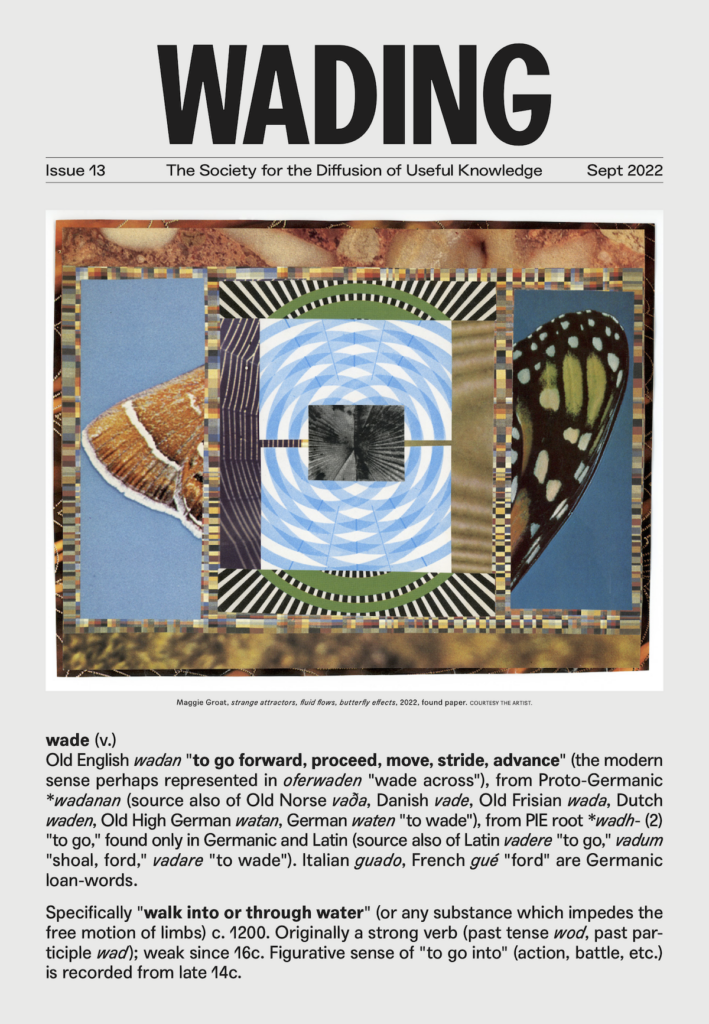
<p>Our thirteenth SDUK broadsheet dives into approaches for navigating social and ecological crises. <strong>WADING</strong> complements the Blackwood’s summer and fall presentation of <em>Lyfeboat prototype</em> and event series, <em>Nearshore Gatherings</em>—both platforms for community engagement with ecology and environmental activism. This issue traverses further from the shoreline into the vast oceans of inquiry on land-based education, institutional critique, biocultural diversity, food and land sovereignty, and equity in the outdoors.</p> <p>Education is crucial in addressing the climate crisis; at its best, it can provide the knowledge, skills, and values to shape agents of change. Departing from the human-centric discourse of the Anthropocene, Fikile Nxumalo’s essay asks: <strong>How might centering</strong> <strong>the more-than-human world in education support a justice-oriented response to environmental precarity?</strong> Citing the omission of Black land relations in environmental education, Nxumalo advocates for the integration of Black ecologies into primary school curricula. Lianne Marie Leda Charlie shares an account of fishing and trapping at the Dechinta Centre for Research and Learning, demonstrating how land-based learning can facilitate Indigenous peoples’ connections to land. Carolynne Crawley’s <em>Water Invitation</em> similarly encourages readers to slow down and reflect on the land and water, to better defend and protect it.</p> <p>Environmental stewardship is a shared responsibility. In many Indigenous worldviews, knowledge is relational, shared amongst all. Through this lens, <strong>how do we collectively wade through climatic and sociopolitical challenges together?</strong> Céline Chuang considers water as a common ancestor and truth-teller; she compels readers to turn to water’s wisdom to unlearn colonial pasts, and rewrite present and future histories. Magdalyn Asimakis reflects on gardening as a key cultural practice of stabilization and survival for many diasporic communities. Maggie Groat’s collages take inspiration from the “butterfly effect,” reminding readers that the actions we take yield divergent dystopian and utopian visions across varying time scales…</p>
Contributors: Madhur Anand, Magdalyn Asimakis, Robin Buyers, Lianne Marie Leda Charlie, Céline Chuang, Carolynne Crawley, Sienna Fekete, The Forest Curriculum, Abhijan Toto, Pujita Guha, Maggie Groat, Aimi Hamraie, Sonia Hill, Maria Hupfield, Asunción Molinos Gordo, Camille Mayers, Fikile Nxumalo, Vasuki Shanmuganathan, Christina Sharpe, Zoë Wool
Print Designer: Matthew Hoffman
Web Designer: Alan Woo
Copy Editor: Joy Xiang